The Real Svetlana
Montreal Is Having a Moment, and the World Is Finally Paying Attention
The bilingual city's creative class has been quietly building something remarkable for years. In 2026, the rest of the world is starting to notice.
If you have spent any time in Montreal over the last few years, you already know what the rest of the world is just starting to figure out. Something is happening here. Not the kind of thing that gets announced at a press conference or launched with a marketing campaign. It is quieter than that, and it has been building for a while. The city's creative class has been doing the work, and in 2026 the results are becoming impossible to ignore.
Start with the food scene, because everyone does. Montreal's restaurant culture has always punched above its weight, but what is happening now goes beyond a handful of celebrated dining rooms. Young chefs are opening spots in neighborhoods that were not on anyone's radar five years ago. The energy has spread from the Plateau and Mile End into Saint-Henri, Villeray, Verdun, and Parc-Extension. The cooking is ambitious without being pretentious, which is a balance that many larger cities struggle with. You can eat remarkably well in Montreal for a fraction of what the same meal would cost in New York or Toronto, and that accessibility is part of what makes the scene feel alive rather than exclusive.
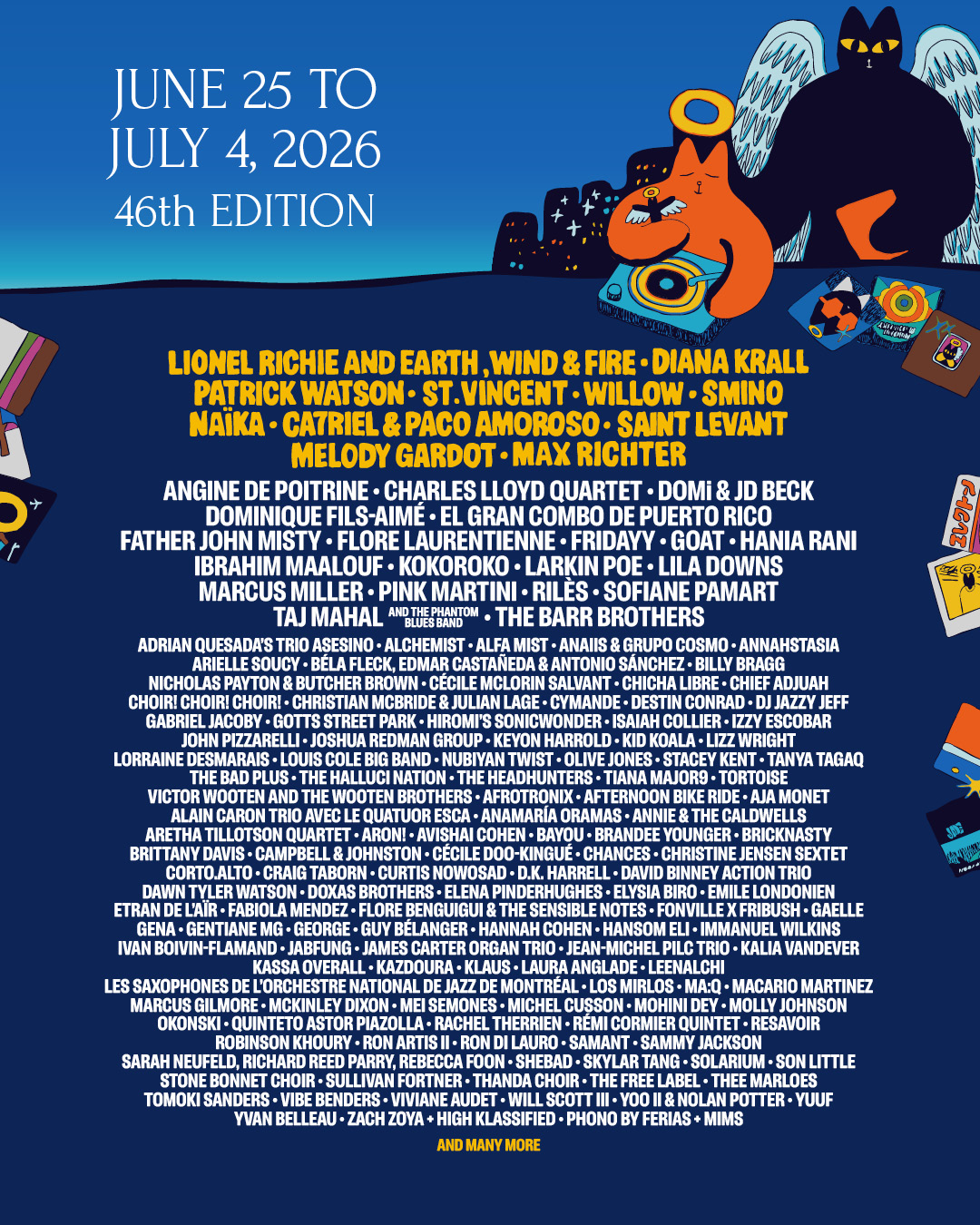
And then there is the music. Montreal has been producing artists that shape international conversations for decades, but the festival infrastructure alone puts the city in a category that most metropolitan areas cannot touch. Nowhere is that more visible than the Festival International de Jazz de Montreal, which returns for its 46th edition from June 25 to July 4, 2026, with over 350 concerts across the city, roughly two-thirds of which are completely free.
This year's lineup is staggering. Lionel Richie and Earth, Wind & Fire headline the Bell Centre. St. Vincent, Diana Krall, WILLOW, Smino, Father John Misty, Patrick Watson, and Larkin Poe are all on the bill. Max Richter brings his cinematic compositions to the concert hall. The Barr Brothers return to the main stage. London's KOKOROKO brings their jazz and Afrobeat fusion back to a city that already adores them. And the free outdoor shows on the TD Stage at Place des Festivals will pack the Quartier des Spectacles every single night for ten days straight.
But the moment that truly captures what this festival does differently is the Donuts 20th Anniversary Celebration. Twenty years after the death of the legendary producer J Dilla and the release of his iconic album Donuts, DJ Jazzy Jeff will headline a tribute night at Club Soda alongside the Montreal Loves Dilla collective. It is exactly the kind of programming that makes the Montreal Jazz Festival more than a music event. It is a cultural institution that understands how to honor history while keeping it alive.
The festival is also marking what would have been the 100th birthdays of Miles Davis, John Coltrane, and Tony Bennett, all born in 1926. Marcus Miller, Davis's final musical director, leads the We Want Miles centennial concert at the Maison Symphonique. Isaiah Collier performs A Love Supreme in its entirety at Theatre Jean-Duceppe. John Pizzarelli takes on the Tony Bennett songbook at Theatre Maisonneuve. These are not nostalgia acts. They are living artists engaging with the legacies of giants in real time, on stages that draw over 2 million guests across ten days.
The bilingual identity of the city is part of what makes it feel distinct from everywhere else in North America. Montreal operates in two languages simultaneously, and that duality creates a cultural texture that is genuinely unique. The anglophone and francophone creative communities overlap and influence each other in ways that produce work you simply would not see coming out of a monolingual city. It is not a gimmick or a tourism talking point. It is the fabric of how the city thinks, creates, and presents itself.
What is driving the current moment is not one single thing. It is the accumulation of years of creative infrastructure, affordable cost of living relative to other major cities, a young population that values culture over corporate ambition, and a municipal attitude that has historically given artists room to experiment. The Formula 1 Grand Prix transforms the city every May. The Jazz Festival owns the summer. Osheaga, MUTEK, Igloofest, and Pop Montreal fill the rest of the calendar. There is no dead period in Montreal's cultural year. Something is always happening, and it is usually worth showing up for.
The fashion scene has been gaining traction as well, with local designers showing at international events and a streetwear culture that reflects the city's particular blend of European sensibility and North American energy. The tech sector has grown without consuming the city's identity the way it has in San Francisco or Austin. The film industry continues to expand, with major productions choosing Montreal not just for tax incentives but for the city's visual character and production talent.
For anyone who covers cities and culture for a living, Montreal in 2026 is the story. Not because it is trying to be the next anything. Because it has spent years quietly becoming itself, and the version of itself it has arrived at is one of the most compelling creative cities on the continent. The world is paying attention now. Montreal has been ready for a while.
The 46th Festival International de Jazz de Montreal runs June 25 to July 4, 2026. Over two-thirds of the 350+ concerts are free. Tickets for indoor shows are available at montrealjazzfest.com.